By: The Nature Conservancy
October 2025
Farmers and landowners with land in select Iowa watersheds can now earn cost-share payments by transitioning row-crop acres to riparian buffers via the new Streamside Buffer Initiative pilot project. This state-funded project, implemented by the Iowa Department of Agriculture and Land Stewardship (IDALS), builds on ongoing efforts to improve water quality. Recent spikes in nitrate levels in the Racoon and Des Moines rivers underscore how essential progress is to Iowa’s future.
Pilot targets key watersheds

The voluntary program is mainly targeted at watersheds upstream from the Des Moines and Cedar Rapids metropolitan areas, specifically:
- Des Moines Watershed
- Middle Cedar Watershed
- Dubuque County
- North Racoon Watershed
- Turkey River Watershed
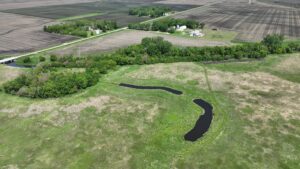
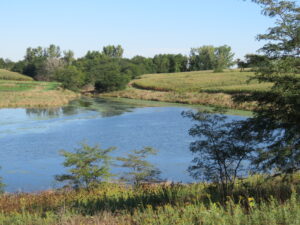
The program encourages the establishment of vegetative streamside buffers. These strips of plants along streams, rivers and creeks help filter out nutrients like phosphorus and nitrates before they flow into these bodies of water.
Susan Kozak, division director at IDALS, says the pilot program is a great way for farmers interested in pursuing conservation to dip their toes in. The program requires relatively limited commitment of time, paperwork and resources, and local support helps shepherd participants through the process.
Pilot program terms and guidelines
The program is more flexible than cost-share programs available at the federal level to encourage even more farmers and landowners to participate. “In many cases, the 10-year maintenance agreement this program entails is easier than a longer-term easement required by other programs,” Kozak explains. “We’ll work with farmers and landowners at the local level to figure out which program is the best fit for their farm.”
Strips of land running alongside creeks, drainage ditches, rivers and streams are eligible. One important caveat is that they must also be taken out of row-crop production. To participate, enrolled buffers must be at least 30 feet wide, on average, and can be up to 100 feet wide on at least one side of the waterway.
The riparian buffers strips should be planted with conservation mixes approved by NRCS. “We rely on their approved perennial vegetation seed mixes, but there’s a lot of flexibility in terms of what’s planted,” Kozak explains, noting farmers can opt to plant these buffers to trees.
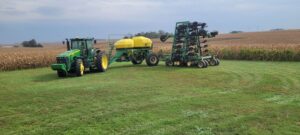
The buffer strips cannot be grazed, but they can be harvested. “The harvestable buffer option allows producers to keep it as working land,” Kozak says. “Because cropland is so valuable in Iowa, it can be difficult for landowners to give up income potential while also paying for upkeep and property taxes. This program allows for flexibility by being able to use for turn-around rows, prevent drown outs in flood prone areas, and don’t require fencing if gleaning crop fields post-harvest of adjacent grain crops.”
Cost share payments for riparian buffer strips
Participants with harvested buffers will receive a one-time payment of $250 per acre for establishment costs and $1,500 per acre for foregone income (for a total of $1,750 per acre). Non-harvestable buffers will receive a one-time payment of $500 an acre for establishment costs and $3,000 an acre for foregone income.
While the full payment is made once at the beginning of the term, the vegetative strips must be maintained for at least 10 years. “Once you’ve seeded it and have that documented, you receive the payment,” Kozak explains. Maintenance involves practices like mowing, burning or spot spraying to make sure the area remains covered by native plants and is not overtaken by undesirable weeds.
Program funding currently stands at $3 million, and IDALS reserves the right to evaluate and approve sites on a case-by-case basis, prioritizing fields where buffer additions may have the biggest impact on erosion and water quality.
“These funds should cover a lot of acres,” Kozak says. “When funds are exhausted, we’ll assess how the program has been going, whether we should invest more money into it, and what changes are needed. The pilot program structure gives us the ability to be flexible and improve for the future.”

Advancing Iowa’s Nutrient Reduction Strategy
Iowa’s Nutrient Reduction Strategy includes a list of approved practices, and converting row crops into perennial vegetation is one of the highest-ranking ones on that list in terms of impact, reducing nitrogen in surface runoff by up to 85%. When coupled with saturated buffers and bioreactors, these systems will have a much more significant impact on nitrogen losses. Buffers also helps to reduce erosion and the runoff of phosphorus, Kozak details.
Farmers and landowners interested in participating in the Streamside Buffer Initiative pilot project should visit their local USDA Service Center to enroll. Find more details about the pilot program here.